
Puerto Rico Lighthouses: Five Coastal Landmarks & Their Stories
From Arecibo to Maunabo: navigation history, coastal scenery and heritage, with visitor access checked individually.
Places, stories and experiences
Lighthouses as coastal memory
Long before modern navigation technology, lighthouses marked dangers and coastal approaches. Their architecture offers a window into Puerto Rico’s maritime history, trade and colonial-era construction. Not all are open museums: distinguish an exterior scenic visit from authorized entry to buildings.
Faro Los Morrillos — Cabo Rojo
Faro Los Morrillos. From the cliffs of Los Morrillos, the lighthouse faces a crucial maritime corridor between the Caribbean and the Mona Passage. Its story belongs to the nineteenth-century effort to guide vessels along Puerto Rico’s coast, when recognizing the shoreline could be essential to safe navigation. Tourist sources disagree on the exact construction date—both 1877 and 1882 appear in Discover Puerto Rico materials—so this guide does not present a single year as definitively settled pending heritage-record verification. Visiting the building and exploring the surrounding landscape are different experiences: even when the interior is not accessible, visitors can learn about approved exterior viewpoints and paths. Salt flats, wildlife refuge habitats and La Playuela add context to the area, subject to access rules. Plan for heat, uneven ground and exposed cliff edges.
Faro Punta Higüero — Rincón
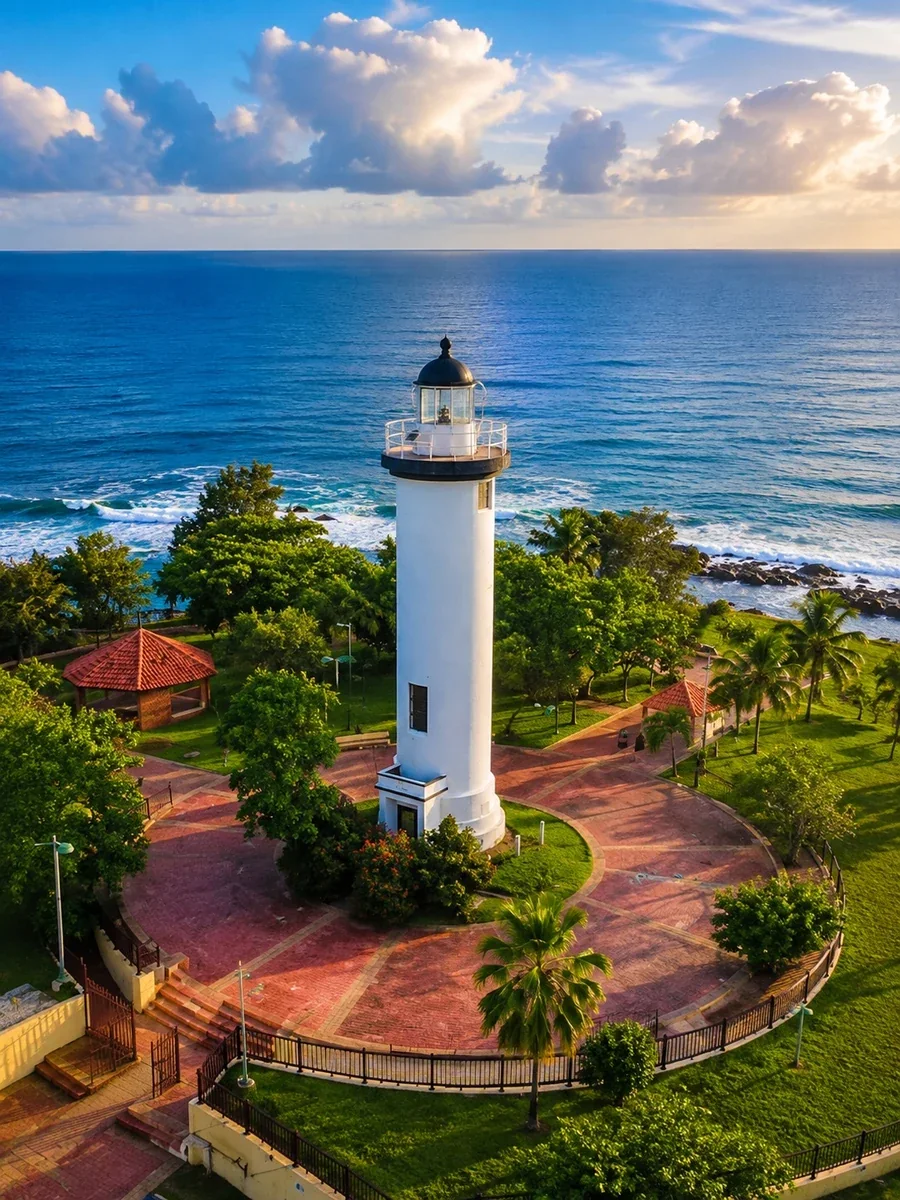
Faro Punta Higüero. In Rincón, Punta Higüero tells a story that did not end with its first construction. The original brick lighthouse dates to 1892, and the 1918 earthquake led to reconstruction. Its position helped connect the maritime signaling system along Puerto Rico’s western coast. Today the surrounding park adds another dimension, with ocean viewpoints, a connection to Domes Beach and a reputation for sunsets. Humpback whales may be seen offshore in season, but sightings are never guaranteed. Think of this as a heritage landmark and coastal park, not an automatic tour of the tower interior.
Faro de Arecibo (Punta Morrillos) — Arecibo
Faro de Arecibo (Punta Morrillos). The Arecibo Lighthouse stands at Punta Morrillos near the entrance to the old port. It was built between 1897 and 1898, at the end of Spain’s period in Puerto Rico. National Register documentation describes a light that helped guide vessels approaching this northern coast. Its neoclassical character connects the structure with a wider historic lighthouse network, while the present-day heritage park offers interpretive experiences subject to separate operating details. Nearby Poza del Obispo is scenic, but not every part of its shore should be assumed safe for swimming. A thoughtful visit can combine coastal history and landscape without confusing park opening arrangements with access to other nearby sites.
Faro Punta Tuna — Maunabo
Faro Punta Tuna. Punta Tuna Lighthouse rises from a peninsula in Maunabo where Puerto Rico’s southeastern coastline meets open water. Built during the 1890s, it belongs to the period when coastal lights linked navigational reference points around the island. Beyond the tower itself, the location reveals why lighthouses were placed on headlands clearly visible from the sea. The landscape rewards a slower visit, but access to the park and building depends on current arrangements. Discover Puerto Rico publishes visitor information that can change, so consult an up-to-date source before making the journey to Maunabo.
Faro de Cabezas de San Juan — Fajardo
Faro de Cabezas de San Juan. Fajardo’s lighthouse belongs to the protected Cabezas de San Juan landscape, where maritime history meets mangroves, dry forest, seagrass habitats and nearby Laguna Grande. The setting helps visitors understand the lighthouse not as an isolated building but as one element of a natural reserve. Access is tied to authorized experiences offered by Para la Naturaleza, which currently notes that restoration work limits or prevents access to the lighthouse building on certain visits. We therefore do not advertise free entry to the tower or guarantee interior access. Reserve through the official channel and follow the organization’s arrival and tour instructions.
Several regional outings, not a race across the island
The north includes Arecibo, the west includes Rincón, the southwest Cabo Rojo, the southeast Maunabo, and the east Fajardo. Treat them as different regional visits rather than a single-day itinerary or a confirmed transport package.
Before you go
Check opening hours and visitor-access arrangements for the lighthouse you plan to visit.
Frequently asked questions
Can you go inside every lighthouse?
No. Hours, restoration work, permissions and access rules vary; check the managing organization.
Can you see all five in one day?
Not as a sensible day trip: they are in different regions of Puerto Rico.
Sources and useful links
Discover Puerto Rico — mapa y principales puntosArecibo Lighthouse — sitio oficialPara la Naturaleza — actividadesDiscover Puerto Rico — faros y patrimonio costeroDiscover Puerto Rico — Faro Punta HigüeroDiscover Puerto Rico — Faro Los MorrillosDiscover Puerto Rico — Faro de AreciboDiscover Puerto Rico — Faro Punta TunaPara la Naturaleza — recorrido Cabezas de San JuanWe can review your request based on the route and availability. Tickets and third-party activities are booked separately.
Ask via WhatsApp