
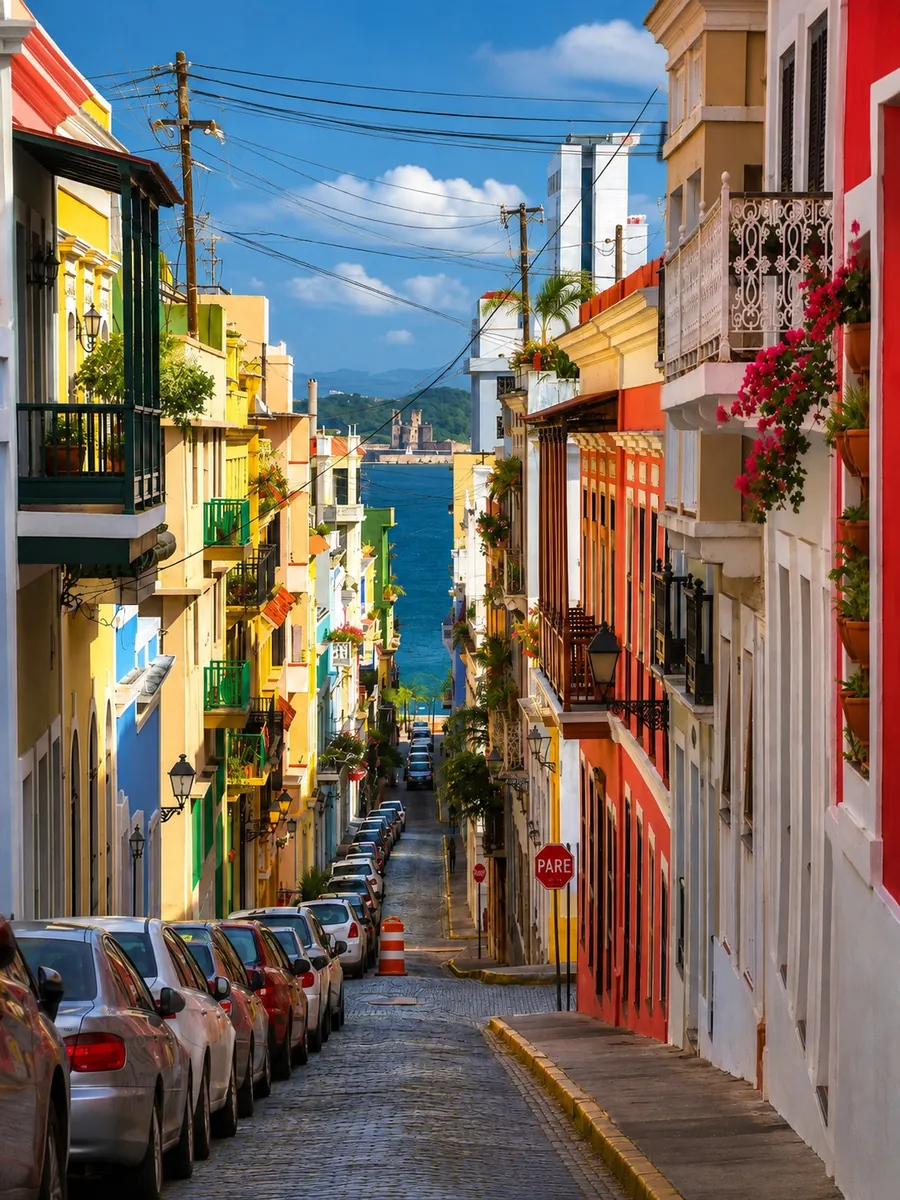
Explore Old San Juan on foot, where historic plazas, colorful streets, local cafés and waterfront promenades meet centuries-old defensive walls. El Morro, San Cristóbal and La Fortaleza recall the city's role guarding the entrance to San Juan Bay; the designated fortifications and sections of walls—not every shop or street in the district—make up its UNESCO World Heritage property. Combine a major landmark with time to browse independent shops, try local food and notice neighborhood details. Walking public streets needs no general reservation, while forts, museums, guided visits and restaurants each have their own hours, fees and booking policies. Expect hills, uneven paving and possible restrictions near official buildings.
Plan a meaningful visit to Old San Juan
History, walkability, attractions, realistic itineraries and useful visitor questions, organized before the detailed places below.
Old San Juan: a city shaped by the sea, its walls and its people
Old San Juan is often introduced through its bright façades and blue-gray cobblestones. Look beyond them and a different story appears: a fortified port that spent centuries adapting to the ambitions of empires, the shape of the bay and the lives of the people who called it home. Its narrow streets now connect military landmarks with churches, plazas, shops, homes and everyday city life. The most memorable walk is one that makes room for both histories.
The Spanish colonial capital moved from Caparra, in present-day Guaynabo, to the San Juan islet in 1521. Its new position mattered because the bay was a valuable Caribbean harbor. Construction of El Morro began in 1539 to guard the maritime approach, while San Cristóbal, begun in 1634, helped defend against attacks from the landward side. The walls and fortifications changed over generations; what survives today reflects more than one period of construction.
This layered history is recognized internationally. La Fortaleza and San Juan National Historic Site received UNESCO World Heritage recognition in 1983. But Old San Juan is not an open-air museum with a fixed script: people still live and work here. Allow enough time to visit respectfully, appreciate the streets between the landmarks and discover the food and culture that keep the neighborhood active.
Why two great forts tell different stories
El Morro and San Cristóbal were built for related but different defensive problems. El Morro looks toward the sea entrance to San Juan Bay; San Cristóbal guarded the approaches from the east, where a land attack threatened the city. The National Park Service traces El Morro’s beginnings to 1539 and the start of San Cristóbal’s construction to 1634, with later engineering work shaping both structures over many decades.
It is worth seeing at least one fort with enough time to walk through its spaces instead of treating it as a photo stop. If visiting both, allow for hills, sun, uneven surfaces and the time required to move between them. The National Park Service is the source to check for current admission, access and any temporary closures.
Sources: National Park Service — San Juan history · National Park Service — Plan your visit
Understanding the forts and their history
Castillo San Felipe del Morro and Castillo San Cristóbal are distinct fortifications managed as part of San Juan National Historic Site by the U.S. National Park Service. El Morro sits at the entrance to the bay, while San Cristóbal defends the land approach. Their ramparts, exhibits and viewpoints reward visitors who allow enough time to walk through the interior rather than simply taking a photograph outside.
The National Park Service lists public access to the fortifications from 9 a.m. to 5 p.m., with closures on Thanksgiving, Christmas Day and New Year’s Day; special programs and changing conditions may affect the schedule. The grounds and walks near the fortifications are not identical to admission-controlled interiors. Check the current official opening information and entrance conditions before you plan around a fort visit.
La Fortaleza is a government building and should not be treated like a permanently open walk-in museum. Security restrictions can affect nearby streets or public access. The names and locations in the accordion guide will help you decide which sites interest you, but every separate building may have its own admission policy.
How to explore on foot without rushing
The historic core is walkable, but some steep streets, uneven paving, steps and sun-exposed stretches can make a short map distance feel longer. Comfortable shoes, drinking water and shade breaks matter, especially with young children or travelers with limited mobility. Check accessibility information for individual museums and forts rather than assuming every historic structure has step-free access.
If arriving at the Old San Juan waterfront cruise piers, many landmarks can be reached on foot; however, the Pan American Pier and other terminals are not interchangeable with those downtown piers. Identify your ship’s actual terminal before planning a walk. If being dropped off by a driver, agree on a realistic meeting location because pedestrianized areas, traffic controls and security zones may change access.
For a shorter visit, choose one of the forts, pass through a principal plaza, and make a lunch or coffee stop. With a longer day, add the cemetery viewpoint, Ballajá, a museum or the Paseo de la Princesa and waterfront. These are flexible examples, not fixed routes or guaranteed walking times.
Food, culture and responsible visiting
The city combines classic Puerto Rican cooking, coffee, bakeries, contemporary restaurants and places for a dessert break. The restaurants below vary considerably: some suit a casual lunch, others require advance reservations or an extended tasting-menu dinner. Use the individual entries to compare what each business actually offers. Menus, prices and opening hours remain subject to change.
Old San Juan is also home to residents, places of worship and working businesses. Stay aware of entrances and sidewalks, avoid blocking narrow streets for photographs, dispose of litter appropriately and support locally owned businesses when possible. Some iconic street decorations change over time, so a photograph seen online may not reflect the current installation on Calle Fortaleza.
Planning with Island Ride PR
A guide to Old San Juan does not require private transportation to enjoy: much of the historic area is intended for walking. Transport can still be useful for getting there from a hotel, airport-area accommodation or other part of Puerto Rico, and for coordinating a return after a long day.
Island Ride PR provides private ground transportation independently of admission fees, meals, museum tours or reservations. When requesting a ride, share your group size, pickup point, planned stops and preferred return time. If your group has mobility or luggage needs, mention them before booking so the plan can be evaluated properly.
Frequently asked questions
Do I need a ticket to walk around Old San Juan?
No general ticket is required to walk the public streets. The forts, museums and other individual attractions may have separate admission rules.
Are El Morro and San Cristóbal the same fort?
No. They are separate parts of San Juan National Historic Site with distinct positions and histories.
Can I walk there from my cruise ship?
That depends on the terminal. Downtown Old San Juan piers are close to the historic center, whereas other terminals require transport.
Is Old San Juan accessible for every traveler?
It has hills, uneven pavement and historic buildings with variable accessibility. Review each site and plan transport and breaks as needed.
How much time should I allow?
A few hours can cover a highlight or two; a longer visit supports forts, plazas, museums and meals. Choose based on mobility, interests and opening hours.
Explore 35 places and experiences
Open the places that catch your attention. Each one explains what makes it worth a stop, what to expect and how it can fit naturally into your walk through the old city.
Historic landmarks, streets and cultural places
01Castillo San Felipe del Morro
El Morro guards the mouth of San Juan Bay from a high promontory. Its six defensive levels developed from 1539 over more than two centuries, and visitors can explore artillery positions, casemates, ramps and grand Atlantic views. Look for the historic lighthouse and imagine ships entering the harbor beneath the cannons. The wide lawn in front is also famous for family picnics and kite flying; this open-air activity is separate from entering the fort. Standard self-guided entry to the interior uses National Park Service admission during park hours, not a required advance guided-tour reservation. The NPS operates without cash and its fees, holiday closures, accessible sections and ranger programs must be checked before visiting; public grounds have different access rules from secured fort rooms. Expect sun, wind, sloping paths and stairs. A self-guided route can include the exterior even when visitors choose not to enter the ticketed interior.
02Castillo San Cristóbal
San Cristóbal protected Old San Juan from eastern attacks by land, unlike El Morro's sea-facing defenses. Begun in 1634, the immense fortress developed with bastions, tunnels, a deep dry moat and sentry boxes; the NPS identifies it as the largest Spanish-built fortification in the New World. Highlights include military exhibits, cannon openings, panoramic coastal views toward Condado and a viewpoint associated with the legend of the Garita del Diablo. A normal visit is self-guided during NPS fort operating hours with paid admission, and the current standard pass connects it with El Morro for a limited period. Special tunnel programs and ranger-led activities depend on staffing and schedules: do not promise them as part of a flexible route. Wear comfortable shoes for uneven paving, ramps and stairs, and verify fees, accessible areas, closures and weather on the official site.
03Catedral de San Juan Bautista
The Metropolitan Cathedral Basilica of San Juan Bautista, at 151 Calle del Cristo, is a living place of worship and one of Old San Juan's earliest colonial landmarks. The congregation traces its beginnings to 1521; storms damaged the first wooden church, while the stone structure changed over subsequent centuries. Visitors interested in art and history may see the marble tomb of Juan Ponce de León and the shrine of Our Lady of Divine Providence, patroness of Puerto Rico. The cathedral remains the seat of the Archdiocese, so Mass, weddings and other religious use take priority over sightseeing. Interior access and service schedules can change; respect worshippers, dress and photography rules, and check the operator's current information. A regular cultural stop should not be described as a guaranteed guided tour, or a museum open at all hours.
04Puerta de San Juan
Puerta de San Juan is one of the surviving gates through the fortified city walls. Facing San Juan Bay, it once provided the ceremonial approach for arriving dignitaries and today is a photogenic pedestrian connection from the waterfront and Paseo de la Princesa into the old streets above. The NPS documents the gate's historical function and restoration; it is not a vehicle drop-off entrance or a booked attraction. Under the park's published rules, the gate normally remains accessible around the clock but may close temporarily for severe weather or security measures near the Governor's residence. The neighboring Paseo del Morro is a separately administered trail; its access cannot be inferred from the gate being open. Check conditions and expect cobblestones, slopes and exposed sunshine during your walk.
05Paseo de la Princesa
Paseo de la Princesa follows the southern waterfront beneath Old San Juan's walls, offering shade, fountains, elegant lamp posts and views of the bay as it approaches Puerta de San Juan. It works well as a free-form scenic walk or a pause between historic sites; visitors need not buy a tour or reserve a time to enjoy the public promenade. Discover Puerto Rico describes weekend craft vendors and some musical activity, but market stalls, performers and cultural events may change and cannot be promised on a particular day. The adjacent Princesa Cocina y Cultura is an optional restaurant, not a meal included in the walking route. Check weather and any path or event restrictions, and do not assume the separately managed Paseo del Morro trail has the same opening status.
06Plaza de Armas
Plaza de Armas was established as Old San Juan's main civic square during the Spanish colonial period and remains an easy starting point for discovering the old city's streets. Look toward the San Juan City Hall and Puerto Rico Department of State buildings flanking the plaza, then find the bronze sculpture honoring salsa composer Tite Curet Alonso, an especially meaningful local cultural landmark. The public benches make this a useful rest stop after climbing the cobbled streets; nearby cafés and bakeries offer optional coffee or a Puerto Rican pastry, without assuming any particular shop will be open. Without needing a show or tour, the plaza offers a flexible free outdoor pause for architecture, city life and local music history. Events, traffic restrictions, vendors and any temporary construction may change.
07La Fortaleza / Palacio de Santa Catalina
La Fortaleza, also called Palacio de Santa Catalina, grew from a 16th-century defensive structure into Puerto Rico's executive residence and office. Its setting at the end of Calle Fortaleza is part of the city's UNESCO-listed heritage, but it remains an active government and security-controlled property. A self-guided Old San Juan walk can explain the building's history from permitted public viewpoints without relying on interior entry. The official Tourism Guides Office separately offers educational tours by prior coordination, covering areas such as the original fort, round tower, wall terrace and gardens when permitted. Its own rules require appropriate dress and a valid photo ID or passport for adults; tour reservations and access may change without notice. The official tour page is the appropriate place to request the visit; do not turn a booked palace tour into a guaranteed spontaneous route stop or imply free entry through security barriers.
Official tours require advance coordination and valid photo identification.
08Iglesia San José
Iglesia San José stands in the upper Old San Juan historic district, its construction beginning in 1532 as part of a Dominican convent. One of the oldest surviving churches in the Americas, it preserves rare Gothic-influenced stone vaults and religious art, and it reopened in 2021 following nearly two decades of conservation. The church is the resting place of Puerto Rican painter José Campeche. Juan Ponce de León was buried here for centuries, but his remains were later transferred to the Cathedral; do not identify San José as his current tomb. A respectful visit can reveal historic arches, sacred art and the story of restoration, rather than just a photo of the façade. It remains a religious site, and entrance, services and restricted areas may change: check current access and do not promise an included guided tour.
09Museo Casa Blanca
Museo Casa Blanca brings early colonial life down to human scale, away from the fortress walls. Built in 1521 as a residence intended for Juan Ponce de León and his family, it became the home of his descendants: Ponce de León himself died before moving in, so the building should not be called a residence he personally occupied. Today the Institute of Puerto Rican Culture manages historic rooms, furnishings, 16th- and 17th-century objects and gardens where visitors can appreciate domestic architecture and the early history of San Juan. The museum pairs naturally with Ballajá, San José Church and El Morro on foot, though entering the collections depends on opening hours and admission. Discover Puerto Rico publishes a split schedule with a midday break; always verify current museum hours, holidays and exhibits before planning an indoor stop. Gardens and interiors may have different temporary access conditions.
10Museo de las Américas / Cuartel de Ballajá
Museo de las Américas occupies the second floor of the monumental Cuartel de Ballajá, a Spanish barracks constructed between 1854 and 1864 around a vast inner courtyard. Founded in 1992 by cultural preservation leader Ricardo Alegría, the museum explores the layered identities of Puerto Rico and the Americas through Indigenous heritage, African roots, folk arts and the difficult history of conquest and colonization. Its permanent 'Conquista y Colonización' exhibition uses six galleries to examine Taíno-Spanish contact and the contributions of Taíno, African and Spanish cultures, with other art and temporary exhibitions changing by season. You can appreciate the architecture and courtyard as part of a walk in the Ballajá district; entering the museum's second-floor galleries is a separate paid admission during its published schedule. The operator's weekday hours have a midday break, and holiday dates, gallery access and ticket prices may change. Educational guided tours are a separately requested group service, not included or necessary for a standard self-guided museum visit. Nearby Café Don Ruiz is an optional coffee stop, not part of museum admission.
11Paseo del Morro
Paseo del Morro is a scenic pedestrian trail at the foot of the monumental western walls, starting near Puerta de San Juan and following the rocky shore toward El Morro. It offers a rare low-angle view of the fortifications, San Juan Bay and the historic stonework, but it is a walking path rather than a vehicle stop or the separately operated Paseo de la Princesa. The National Park Service's 2026 Superintendent's Compendium lists public access seven days a week from sunrise to sunset. An archived NPS notice from June 2023 announced a closure for a wall water leak; because that notice is historical and the newer policy describes regular access, the old notice does not establish a current total closure. Nevertheless, damage, weather, repairs and signs on site can still restrict sections—verify with NPS before promising a continuous walk. Motor vehicles, bikes, skates, skateboards and fishing are prohibited; dogs must be leashed. Plan comfortable footwear and time for the approximate 1.5-mile out-and-back distance published by NPS, with exposed heat and minimal shade. No guided service or reservation is required for ordinary use when open.
12Capilla del Cristo
At the end of Calle del Cristo near Tetuán stands the Capilla del Santo Cristo de la Salud, a compact historic chapel above the old city wall. The Library of Congress records its construction as beginning in the 18th century, while local tradition tells of a horse-racing accident and a miraculous rescue. Historical retellings disagree with the miraculous ending, so it should remain a legend, not a documented rescue. The architecture and adjoining street corner make this a worthwhile short exterior stop even when its doors are shut. Visiting the interior depends on limited, changeable opening times; verify access before planning to enter.
Interior access is limited to certain days and hours.
13Cementerio Santa María Magdalena de Pazzis
Santa María Magdalena de Pazzis is an active 19th-century cemetery dramatically set between Old San Juan's northern walls, El Morro and the Atlantic. Its white tombs, mausoleums and funerary sculptures create a striking landscape and preserve the memory of generations of Puerto Ricans, including prominent cultural figures. Discover Puerto Rico links the location outside the walls and beside the ocean to historical beliefs about death and the journey beyond; present that as cultural interpretation, not established fact about every burial. The site is still a place of mourning, so maintain silence and respect for families and ceremonies. Views from outside the grounds can be enjoyed during an Old San Juan walk, while entering the cemetery depends on gates, permitted hours and any services underway. Verify access before offering an interior visit; no tour, cemetery entry or unrestricted photography is promised by a self-guided route.
Historic active cemetery; visit respectfully and verify access hours before entering.
14La Rogativa
La Rogativa is a small historic plaza beside La Fortaleza on Caleta de las Monjas, with views across San Juan Bay and bronze figures commemorating a women-led religious procession. The sculpture evokes a well-known story from the British attack of 1797: according to local legend, torchlight from the procession made attackers imagine reinforcements and helped end their attempt. It is important to present that explanation as legend, not a fully proven military cause. For visitors this is a short scenic and cultural pause between the San Juan Gate, historic walls and nearby streets, not a scheduled performance. The plaza is generally an outdoor public viewpoint, but weather, special events or government security can temporarily affect access; keep photography and pedestrian navigation respectful near the Governor's residence.
15Plaza del Quinto Centenario
Plaza del Quinto Centenario was created in 1992 for the 500th anniversary of Columbus's first voyage to the Americas. The contemporary square contrasts with Old San Juan's colonial streets, centered on the 40-foot granite-and-clay Tótem Telúrico, a monument intended to symbolize the emergence of what European explorers called the 'New World'. Present this as the original commemorative interpretation, while recognizing that the voyage and colonization are also part of a more complex Indigenous and Caribbean history. From this open-air plaza, visitors can orient themselves toward the Cuartel de Ballajá, Calle del Cristo and El Morro, making it a useful short architecture and photo pause before choosing whether to enter a museum or fort. The plaza itself is not an admission-ticketed tour; events, temporary closures and any installations may change, and access to adjacent paid sites follows their own rules.
16Calle Fortaleza
Calle Fortaleza is part of Old San Juan's everyday life: colorful façades, balconies, restaurants, shops and a walk leading toward La Fortaleza, the Governor's residence. It became famous as Umbrella Street, but Discover Puerto Rico documents changing overhead displays, including butterflies, kites and other installations instead of a permanent row of umbrellas. Enjoy the architecture and local businesses along the public portions without promising a specific decoration. Near the Governor's residence, respect any security barriers, special-event closures or restricted segments.
Walk the historic-commercial corridor toward La Fortaleza; decorative installations change over time.
17Calle San Sebastián
Calle San Sebastián changes character over the course of a day. Its colorful buildings and local businesses reward a daytime walk; later, bars and restaurants help make it a center of Old San Juan nightlife. The street is also associated with the Fiestas de la Calle San Sebastián, when artisans, cabezudos, music and crowds fill streets across the historic district. That huge celebration is an annual event, not something visitors will encounter on an ordinary day. Walk and choose a place to eat or drink when open, and check the municipality's actual festival schedule and access restrictions if visiting in January.
Lively cultural street tied to nightlife, art and the annual SanSe festival.
18Teatro Tapia
Teatro Alejandro Tapia y Rivera opened in 1832 and is one of Old San Juan's enduring cultural venues. Its yellow-and-white neoclassical façade, arches and elegant small balconies stand beside Plaza Colón, across from the Antiguo Casino; inside, its intimate multi-level auditorium has traditionally welcomed concerts, plays and comedy. Even without a ticket, appreciating the façade and imagining the city's theatrical history makes it a worthwhile architecture pause on a self-guided walk. Entering the auditorium is a different activity: performances require their own event schedule and sometimes ticket purchases, and a regular pedestrian route never guarantees a rehearsal, show or public interior tour. Look at the current municipal or authorized box-office program before planning an evening performance, including date, age guidance, seating and current prices. Do not list an old show's ticket rate as a standing admission fee; performances, building access and temporary closures may change.
Check the current program if you want to attend a performance.
19Antiguo Arsenal de la Marina Española
At La Puntilla, the Antiguo Arsenal de la Marina Española reveals a side of San Juan shaped by ships, harbor defense and maritime workshops rather than only its famous forts. EnciclopediaPR dates the permanent masonry arsenal to 1800 and describes stores for arms and ammunition, shipbuilding and repair facilities, and later additions. Today the Instituto de Cultura Puertorriqueña uses the former complex for administrative functions and occasional exhibitions or events. Its exterior is meaningful on a waterfront history walk, but do not count on entering the buildings without checking the current exhibition and access schedule.
Interior access depends on current exhibitions or events.
20La Perla
La Perla is a living seaside community between El Morro and San Cristóbal, beyond the northern walls of Old San Juan—not an empty mural backdrop or a sightseeing attraction designed for vans. Discover Puerto Rico traces its history to the former slaughterhouse area and generations of residents excluded from the walled city, and describes community-led revitalization, painted houses, murals and neighborhood businesses. The 2017 'Despacito' video brought international attention, but residents, artists and local organizations were shaping the area long before. If interested in learning about the neighborhood, prioritize a daytime walk accompanied by a community leader or local guide; Discover Puerto Rico advises against visiting alone at night. Ask permission before photographing people or homes, respect private property and changing community conditions, and do not enter expecting every workshop, business or mural to be available. This section provides cultural context: it is not an automatic van stop, unrestricted self-guided route or included pre-booked tour. Guided opportunities and access details may change and should be confirmed.
For deeper context, a local guide is a good option.
Food, coffee and local flavors
21Café Manolín
Café Manolín at 251 Calle San Justo is a longtime Old San Juan neighborhood dining institution, not an elaborate tasting restaurant. Its operator recounts more than 70 years of history, starting with founder Ernesto Ruiz, passing through his brother Manolín Ruiz and continuing under owners Annie Rivera and Tomás J. Molina from 1987. Residents, workers and visitors go for hearty Puerto Rican breakfast and lunch: the official menu lists mofongo stuffed with shrimp, chicken or steak, arroz con habichuelas and amarillos, chicharrones de pollo and a daily lunch special. The operator also highlights sancocho on Mondays and serenata de bacalao with pernil and arroz con gandules on Fridays, but weekday specials can change. Choose it for straightforward local criollo cooking and a sense of daily San Juan life, with time for a relaxed meal. Menu items, prices, serving hours and queue lengths may change; the historically cited Tripadvisor distinction is not presented as a current award.
22Café Don Ruiz
Café Don Ruiz is a locally rooted specialty-coffee stop inside the historic Cuartel de Ballajá, near Museo de las Américas, Plaza del Quinto Centenario and the walk to El Morro. The Ruiz family's business focuses on single-origin Arabica grown in Yauco and roasted to bring out the bean's character; the operator describes a medium-dark specialty roast and offerings ranging from traditional espresso to filter coffee and iced drinks. The shop also promotes freshly baked pastries and food that can make a casual brunch or coffee break. Its Ballajá location adds context: the nineteenth-century former Spanish barracks now house educational and cultural institutions, and the government’s historic-preservation office lists Don Ruiz as a ground-floor tenant. Enjoy the coffee and courtyard area without suggesting that café service includes admission to a museum or a scheduled roasting demonstration. Café menu, baked selections, museum access and business hours are independent and subject to change.
23Café Cuatro Sombras
Café Cuatro Sombras, at 259 Calle Recinto Sur, offers a specific connection to Puerto Rico's coffee-growing mountains, not simply another coffee counter. The company traces its farm-to-cup heritage to Hacienda Santa Clara in Yauco, where it grows single-origin Arabica coffee using shade-grown, selectively hand-picked beans; its own account describes same-day processing and sun-drying. Discover Puerto Rico characterizes the cup as medium-bodied with semi-sweet chocolate, caramel and spice notes. Try an espresso or brewed coffee to appreciate that profile, then add a pastry, panini, sandwich or light breakfast according to the day's menu. The stop is useful for visitors who want to taste a locally grown product and learn where its beans come from before continuing the Old San Juan walk. Café service is NOT a guided plantation tour in Yauco; coffee selections, food, seating and opening hours may change.
24Chocobar Cortés
Chocobar Cortés at 210 Calle San Francisco is a restaurant built around the Caribbean chocolate-making heritage of the Cortés family, whose company began in 1929; the Chocobar concept opened in 2013. Its appeal goes far beyond a dessert counter. The Old San Juan operator's current menu serves brunch throughout the day and uses chocolate in savory ideas such as the Chocoburger with chocolate ketchup, mofongo with churrasco and chocolate mayonnaise, alongside bonbons, house-made pastries and chocolate desserts. A memorable cultural taste is the traditional Puerto Rican hot chocolate served with a small cube of cheddar cheese; the restaurant also offers a 70%-cacao Puerto Rican dark-chocolate drink. Guests can come just for a chocolate beverage or plan a full meal. These are examples from an operator-published menu, not an assurance that every item, preparation or table will be available on arrival. Reservations, allergens, menu changes, prices and hours may change. This is the Old San Juan location, not the separate Condado restaurant.
25La Casita de Rones de PR
La Casita de Rones de Puerto Rico sits at Plaza Dársenas on Calle Comercio, facing San Juan Bay and the cruise-port waterfront. Its official site describes two bars, a restaurant and a flagship shop devoted to Puerto Rican rum culture, making it an atmospheric stop near the piers and Old San Juan promenade. The operator's food menu goes beyond bar snacks: examples include carne frita with mayo-ketchup, crispy chicken chicharrón, fish tacos in bacalaíto-style batter, rum-glazed chicken wings, pernil sliders with a rum-guava barbecue sauce and signature stuffed mamposteao. Try the flavors that appeal to your group while learning about local rum traditions; alcoholic drinks are optional and the kitchen also has food-only choices. The restaurant, bars and shop have different uses; an independent meal is not a reserved rum tasting or guaranteed educational tour. The brand advertises reservations and holiday programming, but tables, prices, menus, waterfront events and any specialized experience remain operator-dependent / subject to change. Do not promise live music or distillery access.
26Princesa Cocina y Cultura
Princesa Cocina y Cultura lies among trees beside the historic walls at Paseo de la Princesa, making a sit-down meal feel connected to Old San Juan's waterfront history. The operator says its cooking draws on six cookbooks published between 1859 and 1950 plus family recipes, joining Puerto Rican traditions with Caribbean and international touches. Island rum culture and cocktails shape the venue, but eating here does not include a guaranteed guided rum tasting. It is a good optional pause after walking the promenade or visiting nearby historic gates. Reservations are recommended but walk-ins are explicitly welcome; official rules allow two hours per reservation and a 15-minute arrival grace period. Published live-music programs, event offers, menus and schedules may change rather than guaranteed. Check the official reservation page for the current hours and table options; do not place fixed prices or a paid experience in a spontaneous self-guided route.
27La Tortuga Bistro Bar
La Tortuga Bistro Bar at 116 Calle San Sebastián is a casual Old San Juan stop for lunch, brunch or drinks. The business-managed listing mentions pizza, sandwiches and empanadas; its social posts also feature handmade varieties. This matters because older tourism records still refer to La Tortuga Pizzería & Panadería at a different address: navigate to the current Bistro Bar name and 116 San Sebastián, not the former bakery listing. Stop here for an informal meal amid the old city's northern streets, with Puerto Rican flavors alongside familiar casual fare; visitors mention malanga fries, but individual dishes are not guaranteed. The business advertises music on selected nights, not every evening. Check current opening hours, menu, music, seating and reservation possibilities directly before a time-specific or group visit: all may change and should be confirmed. This is a food recommendation within Old San Juan, not a reserved tour or separate route attraction.
28La Factoría
La Factoría at 148 Calle San Sebastián is one of Puerto Rico's internationally recognized cocktail destinations, created in 2013 and built as an interconnected set of six spaces rather than one ordinary bar. Wander between the front room, wine-focused Vino, dance-oriented Shing A'Ling and other themed rooms to experience the venue's mix of music, local nightlife and inventive cocktails. Discover Puerto Rico identifies signature drinks such as the Lavender Mule and Spiced Old Fashioned; the authoritative North America's 50 Best Bars 2026 list ranked La Factoría No. 26 and specifically named it the Caribbean's Best Bar for that edition—not an unqualified claim that it remains the world's No. 26 forever. Essential planning details from the official venue: admission is 23+ with valid ID, regular seating is first come, first served and reservations are not accepted. Its published program lists live salsa in Shing A'Ling Sundays/Mondays and DJs on selected nights, but these schedules may change, not guaranteed performances. An individual stop does not automatically include a dance class, a tasting package or entrance to a private event. Best considered an adult evening/nightlife experience; confirm age rules, hours and programming before visiting.
29La Taberna Lúpulo
La Taberna Lúpulo at 151 Calle San Sebastián is a recognizable Old San Juan craft-beer destination that celebrated 15 years in 2025. The operator advertises roughly 50 rotating draft taps and more than 150 bottled or canned beers, spanning Puerto Rican craft brewing and selections from Belgium, Germany, Britain and the United States; those figures describe the program, not 50 identical beers guaranteed on any visit. Beer lovers can check the live Untappd tap list before choosing a pour. Its kitchen is also part of the experience, with house-made sauces and pub-style favorites the operator identifies as wings, Cubano sandwiches, fish tacos and crunchwraps. That makes it a casual option for guests seeking hearty food and a beer-centric atmosphere rather than formal dining. The business says its kitchen is open whenever the venue is open, but menus, keg changes, individual dishes, seating and late-night hours may change. Beer service remains subject to legal age rules and staff policies; don't promise tastings, performances, awards or daily availability of a particular brew.
30Barrachina
Barrachina, at 104 Calle Fortaleza, combines a historic-looking Old San Juan courtyard dining experience with traditional Puerto Rican and Caribbean cooking. Its published menu includes mofongo stuffed with shrimp, chicken or seafood, Puerto Rican fried appetizers and paella criolla for two, with menus, prices and preparation times subject to change. The restaurant tells a famous story: it credits bartender Ramón Portas Mingot with creating the piña colada there in 1963. That is Barrachina's own claim, NOT settled cocktail history. Caribe Hilton separately credits bartender Ramón 'Monchito' Marrero with creating the drink in 1954, so both accounts should be presented as competing historical narratives rather than awarding exclusive origin to either establishment. Visitors can enjoy the colonial setting and learn the debate while choosing a meal or piña colada; hours, reservations, dishes and seating are operator-dependent. This is one gastronomic/historical-relation stop inside Old San Juan, not a separate historical monument.
31Drunken Cookies
Drunken Cookies began as a Puerto Rican bakery idea at the 2023 Fiestas de la Calle San Sebastián and now serves an unusually playful sweet stop at 151 Calle de la Cruz. Its roughly six-ounce, freshly baked stuffed cookies include signature chocolate chip with Nutella and sea salt, s'mores, cookies-and-cream and fruit-and-cheesecake creations; other flavors arrive in rotating or limited batches. The operator also makes cookie-shot cups lined with chocolate. An important distinction for guests and families: the ordinary cookie dough does NOT contain liquor. At its physical stores the business says a mini liquor shot may accompany a cookie, but adding it is the customer's choice; confirm the age policy and alcohol-free choices with staff. Look for the day's baked selection rather than expecting every online flavor, limited release or shot pairing in stock. This is a quick dessert detour, not a culinary tour or a booked group activity; queues, ingredients, prices and late closing times may change.
32El Jibarito
Restaurant El Jibarito at 280 Calle del Sol is a casual, lively Old San Juan institution built around Puerto Rican comida criolla rather than modern fusion. Its longstanding neighborhood-style setting and murals make a recognizable contrast with the formal restaurants nearby. Regional menu listings and visitor accounts tied to this exact Calle del Sol address mention arroz con habichuelas or arroz con gandules with pork or chicken, garlicky mofongo, bacalaítos, alcapurrias and stewed meats; these are examples, not a guaranteed daily menu. Visitors looking for a hearty local lunch can ask which stew, rice, seafood or plantain preparations are available and how the restaurant serves them today. Reviews are mixed on wait times and consistency, so avoid promising quick service, specific prices, a particular filled mofongo or unanimous acclaim. Do not confuse this Calle del Sol restaurant with other businesses using 'El Jibarito' elsewhere, whose online menus and signature plantain sandwiches belong to different locations. Current opening hours, menu and seating may change.
33La Cocina del Jíbaro Moderno
La Cocina del Jíbaro Moderno at 307 Calle del Recinto Sur offers Puerto Rican countryside flavors interpreted with playful, hearty plates, close to the Doña Fela parking garage in Old San Juan. Business-associated social posts from 2026 highlight their self-described 'Pernil Kan Kan' served with mamposteao de gandules, pastel de pana ('mapén') stuffed with pernil al caldero, fresh mashed-plantain mofongo and bistec encebollado with rice and beans. Those distinctive preparations are reported as the restaurant's own promotions, not as an independently verified claim that it invented an entire Puerto Rican dish. Recent reviews also mention pork, seafood and criollo-style rice, but food and service experiences vary. If guests want something more inventive than a basic lunch counter while keeping a Puerto Rican flavor profile, ask which signature preparations the kitchen actually has that day. This venue is SEPARATE from El Jibarito at 280 Calle del Sol and from other restaurants named Jíbaro. The operator's menu, service times, availability and reservations may change and should be confirmed because no consistently accessible current official menu was confirmed.
34Anita Gelato — Old San Juan
Anita Gelato at 65 Calle Fortaleza is a refreshing dessert break on a walking tour of Old San Juan, especially between the shops, Plaza de Armas and the approach to La Fortaleza. Inspired by Mama Anita’s family recipes, the shop specializes in handcrafted gelato with more than 150 flavors across its rotating collection—not 150 flavors guaranteed at the counter every day. Look for rich pistachio or chocolate varieties, fruit-forward sorbets such as coconut or watermelon with mint, and creative dessert flavors; frozen yogurt, no-added-sugar options and toppings are also part of the brand’s selection. Dairy-free or vegan choices depend on the day's display, so confirm ingredients and allergens with staff. This is a flexible quick sweet stop, not an activity requiring advance booking. Flavor selection, toppings, queues and published late-night hours may change.
35Marmalade Restaurant & Wine Bar
At 317 Calle Fortaleza, Marmalade Restaurant & Wine Bar is a special-occasion evening meal, not a quick stop on a flexible walking route. Chef Peter Schintler's restaurant offers tasting menus only, without an à la carte or children's menu; official materials describe multi-course seasonal selections, plant-forward options and a wine list recognized by Wine Spectator. Its white-bean soup with black truffle is a noted signature, though courses and pairings can change. Parties of six or more follow a different group tasting format. Visitors should reserve ahead through the official booking page and consult current policies, dietary accommodations, menus and prices there; do not assume fixed prices or walk-in availability. Importantly, the operator's homepage says it opens daily in the evening, while its contact page lists Wednesday as closed: opening days and hours may change and should be confirmed until reconfirmed. Plan this as a separate dinner reservation rather than an automatic stop on a self-guided route.
Hours, admission policies and access can change. Confirm details directly with each location.
Continue exploring Puerto Rico
Discover another in-depth guide or browse the full guide library.
La Parguera: bioluminescent bay and cays · All guidesInterested in visiting Old San Juan?
Explore Island Ride PR private transportation or send us a message to plan your visit.
Private transportation WhatsApp